
Polished Marble-Look Porcelain — Large-Format Tile Across an Open Living & Dining Space
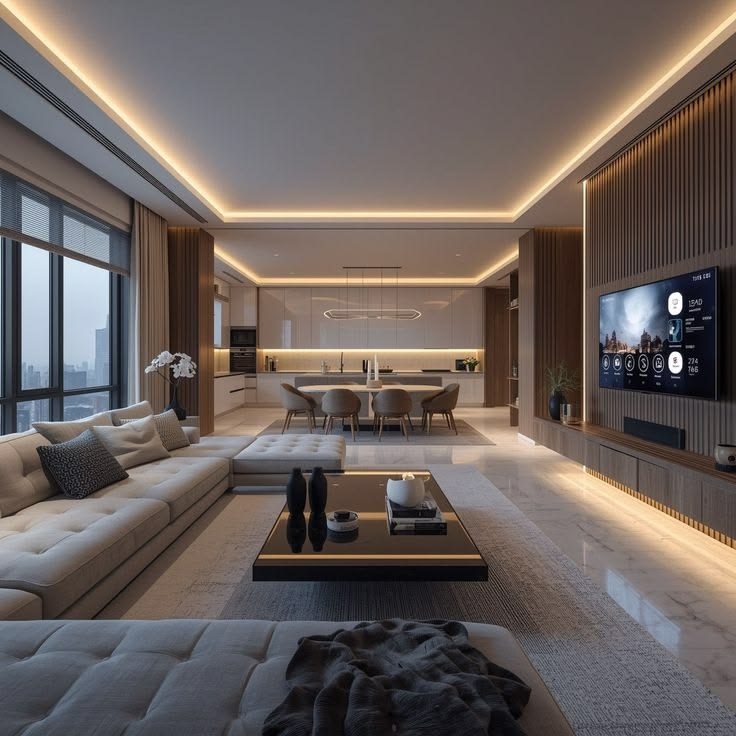
Large-format polished porcelain in a soft marble finish, run continuously through the living room, dining area and kitchen with minimal grout lines.
This is the look most homeowners describe as "marble" without wanting what real marble actually involves. Natural marble stains from a spilled glass of wine, etches from lemon juice, and needs sealing on a schedule. Porcelain gives you the same visual depth with none of that — it does not absorb, does not etch, and does not care what gets dropped on it.
The decision that made this floor work was tile size. Large-format panels mean far fewer grout lines, and grout lines are what break a floor visually and collect dirt over the years. Across an open plan this size, going large is the difference between a floor that reads as one continuous surface and one that reads as a grid.
The polished finish was chosen for a specific reason here: this room relies heavily on indirect and cove lighting rather than strong daylight. A matte tile would have absorbed that light and left the space feeling dim. The polish bounces it back and effectively doubles the perceived brightness after dark. In a room with harsh direct sun, we would have recommended the opposite.
Large-format tile is also the least forgiving material we install. Panels this size telegraph every high and low spot in the slab, so subfloor flatness is checked and corrected before a single tile is set — lippage between panels is the one flaw you can never hide on a polished floor.
Result: a seamless, reflective surface that carries the entire open plan and requires almost nothing to maintain.
This is the look most homeowners describe as "marble" without wanting what real marble actually involves. Natural marble stains from a spilled glass of wine, etches from lemon juice, and needs sealing on a schedule. Porcelain gives you the same visual depth with none of that — it does not absorb, does not etch, and does not care what gets dropped on it.
The decision that made this floor work was tile size. Large-format panels mean far fewer grout lines, and grout lines are what break a floor visually and collect dirt over the years. Across an open plan this size, going large is the difference between a floor that reads as one continuous surface and one that reads as a grid.
The polished finish was chosen for a specific reason here: this room relies heavily on indirect and cove lighting rather than strong daylight. A matte tile would have absorbed that light and left the space feeling dim. The polish bounces it back and effectively doubles the perceived brightness after dark. In a room with harsh direct sun, we would have recommended the opposite.
Large-format tile is also the least forgiving material we install. Panels this size telegraph every high and low spot in the slab, so subfloor flatness is checked and corrected before a single tile is set — lippage between panels is the one flaw you can never hide on a polished floor.
Result: a seamless, reflective surface that carries the entire open plan and requires almost nothing to maintain.