
Smoked Oak Herringbone Hardwood — Diagonal Layout in a Glass-Wall Living Room
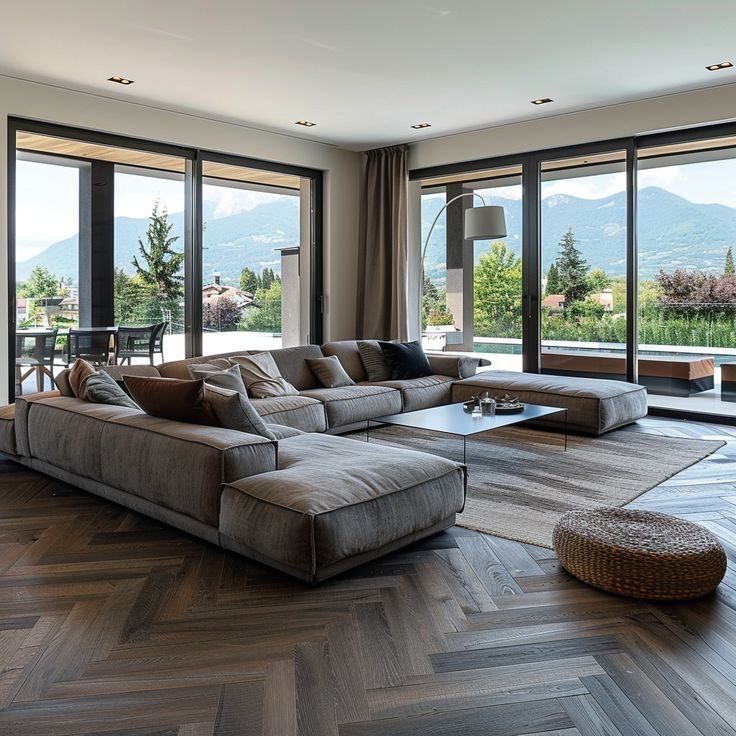
Dark smoked oak herringbone, installed on a diagonal axis across a large open living room framed by floor-to-ceiling glass.
Herringbone is the pattern homeowners ask about most and commit to least, usually because of the price gap. It is worth understanding what that gap actually buys. Every plank in a herringbone floor is cut and set individually at a 45-degree angle, and each one has to meet its neighbor exactly — there is no forgiveness in the pattern. A single plank off by a fraction compounds across the entire run. This is skilled labor measured in days, not hours, and it is the reason herringbone reads as custom the moment you walk in.
We laid this one diagonally rather than square to the walls. In a room this wide, a diagonal axis pulls the eye toward the glass and the view beyond it, and it makes the floor feel like it extends past the walls instead of stopping at them.
The color choice was equally deliberate. This smoked oak is dark, but it is not a flat espresso — there is real grain variation and a subtle gray cast running through it, which is what keeps a dark floor from looking heavy in a room this size. The matte finish was non-negotiable here. With this much direct natural light, any gloss would have turned the entire floor into a reflector and washed out the pattern.
Practical note for anyone considering herringbone: it demands a genuinely flat subfloor. We spend more time on preparation for a pattern floor than for a standard plank installation, and skipping that step is where herringbone jobs fail.
Result: a floor that functions as the room's primary architectural feature, not just its surface.
Herringbone is the pattern homeowners ask about most and commit to least, usually because of the price gap. It is worth understanding what that gap actually buys. Every plank in a herringbone floor is cut and set individually at a 45-degree angle, and each one has to meet its neighbor exactly — there is no forgiveness in the pattern. A single plank off by a fraction compounds across the entire run. This is skilled labor measured in days, not hours, and it is the reason herringbone reads as custom the moment you walk in.
We laid this one diagonally rather than square to the walls. In a room this wide, a diagonal axis pulls the eye toward the glass and the view beyond it, and it makes the floor feel like it extends past the walls instead of stopping at them.
The color choice was equally deliberate. This smoked oak is dark, but it is not a flat espresso — there is real grain variation and a subtle gray cast running through it, which is what keeps a dark floor from looking heavy in a room this size. The matte finish was non-negotiable here. With this much direct natural light, any gloss would have turned the entire floor into a reflector and washed out the pattern.
Practical note for anyone considering herringbone: it demands a genuinely flat subfloor. We spend more time on preparation for a pattern floor than for a standard plank installation, and skipping that step is where herringbone jobs fail.
Result: a floor that functions as the room's primary architectural feature, not just its surface.