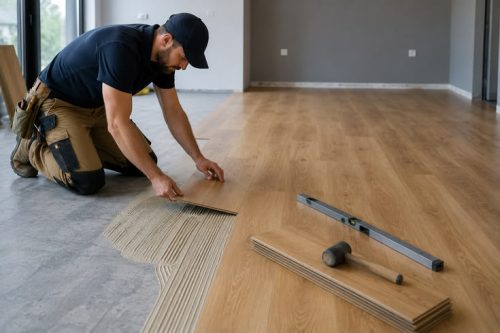
Most flooring failures in North Texas have nothing to do with the flooring. The planks cup, the tile grout cracks, the vinyl telegraphs every bump — and the cause is sitting two inches below the surface, in a concrete slab nobody tested. This guide covers what has to happen to your slab before anything gets installed on top of it.
Why North Texas Slabs Are a Special Case
Almost every home built in Southlake, Keller, Grapevine, Colleyville and the surrounding DFW suburbs sits on a slab-on-grade foundation. That slab rests on the expansive clay soil that runs through this part of Texas — soil that swells when it rains and shrinks hard during a dry August.
Two consequences matter for flooring:
- The slab moves seasonally. Small elevation changes across a room are normal here in a way they are not in other parts of the country.
- The slab holds and releases moisture. Concrete is not waterproof. Vapor travels up from the ground through the slab and into whatever you glue or float on top of it.
A crew that installs the same way in Southlake as they would in Denver will eventually produce a callback. Proper slab prep is the difference between a floor that lasts 20 years and one that fails in the second summer.
The Three Things That Must Be Checked
Before a single box of flooring is opened, three conditions need to be verified: moisture, flatness and cracking. Skipping any one of them voids most manufacturer warranties.
1. Moisture: The Failure Nobody Sees Coming
Moisture is the most common and most expensive slab problem, because the damage shows up months after the installer has been paid. Glue-down hardwood releases, vinyl adhesive softens, laminate swells from the bottom edge, and mold can develop in the adhesive layer.
How it should be tested
The industry standard is in-situ relative humidity testing under ASTM F2170. Probes are drilled into the slab rather than taped to the surface, because the surface tells you almost nothing about what is happening inside.
What the standard actually requires:
- Probe depth is calculated, not fixed — 40% of slab thickness for a slab drying from one side, 20% for one drying from two sides.
- Three test holes for the first 1,000 sq ft, plus at least one more for every additional 1,000 sq ft.
- The building must be at normal service conditions for at least 48 hours before testing — heat or air conditioning running as it will when you live there.
- Probes equilibrate for 24 hours before a reading counts. The standard was updated in 2016 to allow official results at 24 hours; before that it required 72, and some installers still quote the old number.
Most flooring manufacturers set their limit somewhere between 75% and 85% RH for a glue-down installation, and the specific number in your product's warranty is the one that governs. Ask your installer which product limit they are working to, and ask to see the readings in writing.
The test that is not good enough
Taping a square of plastic sheeting to the slab overnight and looking for condensation is a rough field check, not a test. It detects only severe moisture, it produces no documented number, and no manufacturer will honor a warranty claim based on it. If that is the only "testing" being offered, keep asking questions.
If the slab reads high
High readings do not necessarily mean waiting months for the slab to dry. The usual fixes are a roll-on moisture vapor barrier or a two-part epoxy membrane applied to the slab, rated to the RH level measured. There is also a materials answer: a click-together floating floor over a vapor-barrier underlayment is far more tolerant of slab moisture than anything glued down. Our guide on SPC vs WPC vs luxury vinyl covers which constructions handle it best.
2. Flatness: Why Your New Floor Feels Hollow
Flatness and level are not the same thing. A slab can slope gently across a room and still take flooring beautifully; what causes problems is a surface that dips and humps over short distances.
Most manufacturers specify a tolerance in the range of 3/16 inch over a 10-foot span, with tighter numbers for large-format tile and some rigid core products. Your installer should be checking this with a straightedge or laser before quoting, not discovering it on install day.
What happens when flatness is ignored:
- Rigid core vinyl and laminate: the locking joints flex over voids, then click, separate or crack along the seam line.
- Large-format tile: hollow spots under the tile and lippage at the edges, where one tile sits proud of its neighbor.
- Engineered hardwood: bounce and squeak underfoot, and stressed adhesive bonds.
The fixes are self-leveling compound for low spots and grinding for high spots. Both are normal, routine work in DFW homes — but both take time and money, which is exactly why some quotes quietly leave them out.
3. Cracks: Cosmetic or Structural?
Nearly every slab in North Texas has cracks. The question is which kind you have.
| What you see | Usually means | Action before flooring |
|---|---|---|
| Hairline cracks, no height difference | Normal concrete shrinkage | Fill and patch; proceed |
| Crack wider than about 1/8", edges level | Shrinkage or minor movement | Epoxy fill; crack isolation membrane under tile |
| One side of the crack sits higher than the other | Active foundation movement | Structural evaluation before any flooring |
| Cracks plus sticking doors, drywall cracks at corners | Foundation issue, not a floor issue | Foundation engineer first |
| Damp or discolored cracks | Possible plumbing leak under slab | Plumbing leak test before anything else |
This is the honest part of the conversation that costs a flooring company a sale: if the slab is still moving, new flooring will move with it. Any contractor willing to install over visible vertical displacement without saying a word is not protecting you. If water is involved, our guide on repairing vs replacing water-damaged flooring explains how to tell how far the damage has travelled.
Which Floors Forgive a Difficult Slab?
| Flooring type | Moisture tolerance | Flatness demand |
|---|---|---|
| Porcelain / ceramic tile | Excellent | High — especially large format |
| SPC rigid core vinyl (floating) | Excellent | Moderate |
| WPC vinyl (floating) | Excellent | Moderate — thicker core bridges minor dips |
| Glue-down LVP | Depends entirely on slab RH | High |
| Engineered hardwood (floating) | Good with proper underlayment | Moderate to high |
| Engineered hardwood (glue-down) | Requires tested slab, often a barrier | High |
| Solid hardwood | Poor over slab — rarely recommended | High |
| Laminate | Moderate — edges swell if water reaches them | Moderate |
This table is why the slab assessment should happen before you fall in love with a product. A slab reading 88% RH narrows your options immediately, and finding that out after you have chosen glue-down hardwood is an expensive detour. For the hardwood question specifically, see engineered vs solid hardwood for Texas homes.
What Slab Prep Adds to Time and Cost
Prep is real work with real materials, and an honest quote shows it as a line item:
- Moisture testing: typically a flat fee, with results in 24–48 hours once probes are set.
- Self-leveling compound: priced per square foot of affected area, plus 12–24 hours cure time before installation starts.
- Grinding high spots: usually priced by the hour or by area; dusty but same-day.
- Moisture barrier coating: priced per square foot, with a cure window before flooring goes down.
- Crack isolation membrane (tile): per square foot over the affected zone.
Expect prep to add one to three days to the schedule on a typical whole-home job. Our day-by-day installation timeline shows where that fits, and the 2026 DFW pricing guide covers what the rest of the quote should look like.
Red Flags in a Flooring Quote
- "Prep as needed" with no number. That is a blank line the contractor fills in after demo, when you have no leverage.
- No moisture test mentioned for a glue-down product. The warranty almost certainly requires one.
- A quote produced without anyone walking the slab. Flatness cannot be assessed over the phone.
- Prep priced at zero on an older home. On a 20-year-old DFW slab, zero prep is a prediction, not a measurement.
- Reluctance to put readings in writing. If a manufacturer ever denies a claim, those numbers are your evidence.
For the broader list of things that go wrong on Texas flooring projects, see our guide to the biggest flooring mistakes Texas homeowners make.
Frequently Asked Questions
How long does a new concrete slab need to dry before flooring?
The old rule of thumb was 30 days per inch of thickness, but drying depends on mix design, weather and whether the building is conditioned. Rather than guessing from the calendar, test it: the RH reading is the only answer that means anything.
Can I install flooring over a slab that has cracks?
Yes, if the cracks are stable and the two sides sit level with each other. Hairline shrinkage cracks are filled and covered routinely. A crack with vertical displacement means something is still moving and needs evaluation first.
Do I need a moisture barrier under floating floors?
Over concrete, yes. Most floating installations call for at least a 6-mil vapor retarder or an underlayment with one built in. Even with a product that is waterproof on top, trapped vapor underneath can cause problems.
Is self-leveling compound a permanent fix?
For flatness, yes — once cured, it is a hard cementitious surface that stays put. What it cannot do is stop a foundation from moving. If the cause is active movement, the slab needs addressing before leveling is worth doing.
My slab feels damp in one spot. What does that mean?
A localized damp area, especially near a kitchen or bathroom wall, can indicate a plumbing leak beneath the slab. That is a plumbing test, not a flooring test, and it should be ruled out before any installation.
Does slab prep really matter if I'm installing tile?
It matters most for tile. Large-format tile is the least forgiving product on an uneven slab, and crack isolation membrane is the standard protection against a slab crack telegraphing straight through your grout lines.
Getting It Right in Southlake and Across DFW
At Southlake Floors TX, every slab job starts with a walk of the subfloor, a flatness check and a moisture plan matched to the product you have chosen — before a quote goes out. We serve Southlake, Colleyville, Grapevine, Westlake, Trophy Club, Keller and the surrounding DFW communities.
Book a free in-home flooring assessment and we will tell you exactly what your slab needs, including when the honest answer is to fix something else first.